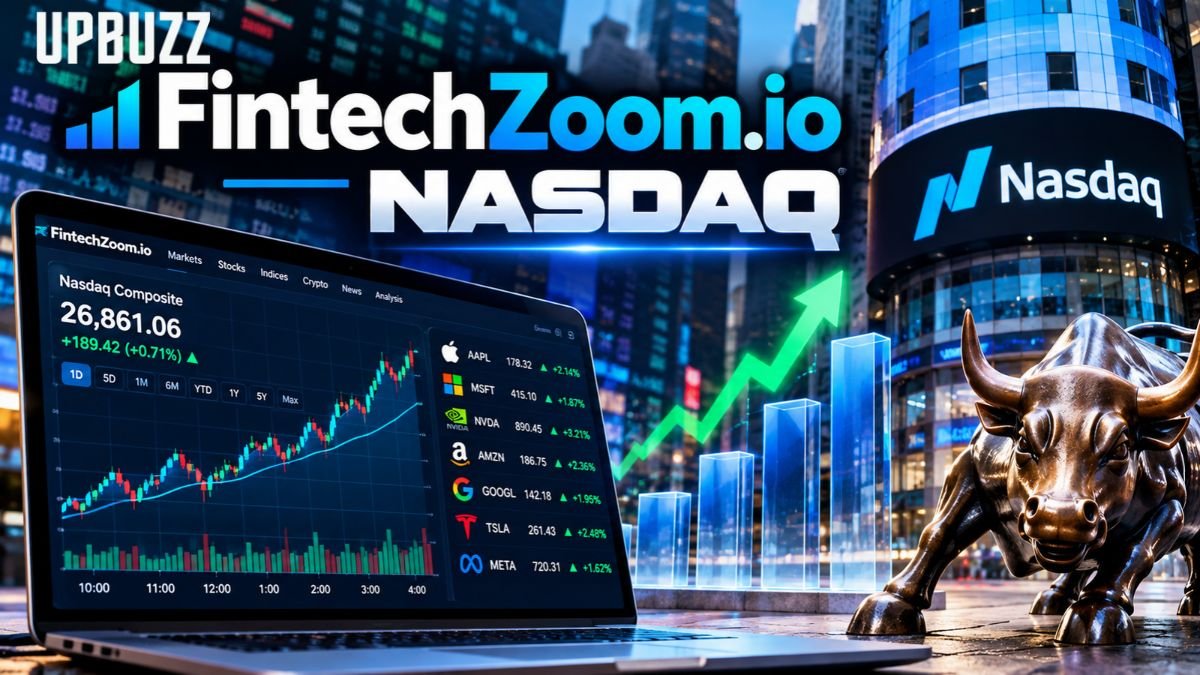
FintechZoom.io Nasdaq refers to FintechZoom.io’s third-party coverage of the Nasdaq market and the Nasdaq Composite rather than an official Nasdaq index, brokerage service or Nasdaq-operated research product. The site presents market commentary and describes features such as charts, technical analysis, stock information and forecasts. For investors, the important distinction is that FintechZoom.io is an information source, while Nasdaq itself is the authoritative source for the Nasdaq Composite’s official index data and methodology.
That distinction matters because some claims on FintechZoom.io’s Nasdaq page go beyond straightforward market reporting and include predictions about future index levels that are not accompanied by a published forecasting methodology.
What is FintechZoom.io Nasdaq?
FintechZoom.io describes itself as a financial-technology media platform covering subjects including stocks, the Nasdaq, Dow Jones, cryptocurrencies, precious metals and real estate. Its dedicated Nasdaq page presents what it calls “Nasdaq FintechZoom,” with an emphasis on tracking the Nasdaq Composite and interpreting market movements.
The page says users can access a performance chart, technical indicators, news and market analysis. It also discusses stock quotes, historical information and broader investment research. Those features place the site in the category of financial information and commentary rather than the underlying market infrastructure itself.
Nasdaq, by comparison, operates The Nasdaq Stock Market and maintains official indexes and index data. Its Nasdaq Composite Index measures Nasdaq-listed domestic and international common-type stocks and is one of the major benchmarks used to follow the performance of companies listed on the exchange.
Readers searching for fintechzoom.io nasdaq should therefore avoid treating the two names as interchangeable. FintechZoom.io can discuss or display information about Nasdaq, but the official index values and rules come from Nasdaq.
What does the FintechZoom.io Nasdaq page offer?
The FintechZoom.io page is designed primarily as an accessible overview for people following technology stocks and the wider Nasdaq market. It promotes several types of information.
Its article describes a performance chart for viewing movements over time, technical indicators intended to help readers examine market trends and a news section covering market developments. It also discusses individual stock data and educational material for investors.
Technical analysis generally involves examining price and trading patterns rather than relying solely on a company’s financial statements or business fundamentals. Indicators can help traders organise historical price information, but they do not establish what an index or stock will do next.
That limitation is particularly important when a financial website moves from displaying market data to making forecasts.
FintechZoom.io’s Nasdaq article contains a table of predicted index points extending through 2032. It gives a figure of 17,500 for 2026 and 28,000 for 2032. However, the page does not provide a transparent forecasting model, assumptions, confidence intervals or supporting methodology alongside that table.
That makes the numbers materially different from official index data. They are projections published by the website, not values supplied or guaranteed by Nasdaq.
How its forecast compares with official Nasdaq data
A useful way to understand this distinction is to compare the FintechZoom.io prediction with an independently verifiable market level.
FintechZoom.io lists 17,500 as its predicted Nasdaq figure for 2026. Nasdaq’s official index service recorded the Nasdaq Composite at 26,861.06 on September 30, 2026.
Because FintechZoom.io does not explain exactly what date in 2026 its prediction represents or publish a methodology on the page, the two figures should not be interpreted as a precise like-for-like forecast test. Even so, the substantial difference illustrates why an undated or loosely defined market projection should not be confused with an official index quotation.
For readers arriving through the fintechzoom.io nasdaq search term, this is one of the most important points to understand: market commentary, technical indicators and forecasts can provide ideas for further research, but an official index provider is the appropriate source when the question is simply, “What is the Nasdaq Composite actually trading at?”
What the Nasdaq Composite actually represents
The Nasdaq Composite is broader than a list of major technology companies.
Nasdaq describes it as an index measuring domestic and international common-type stocks listed on The Nasdaq Stock Market. The official index service shows thousands of constituent securities, which is why the Composite is commonly used as a broad measure of Nasdaq-listed equities.
The index is heavily associated with technology because many large technology businesses trade on Nasdaq, but investors should not assume the Composite contains only technology companies. Its composition extends across multiple industries.
This is also why a move in the Nasdaq Composite should not automatically be interpreted as evidence that every Nasdaq-listed stock moved in the same direction. An index combines many securities into one benchmark, and movements in larger companies can have a greater effect on the overall result.
A market-data page can make that information easier to consume, but understanding the benchmark itself is essential before using charts or commentary to make investment decisions.
Is FintechZoom.io a reliable source for Nasdaq information?
The answer depends on what information a reader needs.
For discovering topics, reading commentary or getting a general overview of market terminology, FintechZoom.io may serve as a secondary research source. Its Nasdaq article covers the exchange, the Composite, technical analysis and general investment concepts in one place.
However, several aspects of the page mean readers should independently verify important information before acting on it.
Most importantly, the page makes forward-looking market predictions without presenting the underlying calculation method. It also uses strong promotional language about real-time information and investment tools. Claims about market-data speed, predictive ability or future performance should therefore be checked rather than assumed to be independently validated.
The US Securities and Exchange Commission’s Office of Investor Education and Advocacy has specifically warned investors not to make investment decisions solely from information published on investment-research websites. Its guidance recommends thoroughly researching securities and independently verifying information before investing.
That principle applies regardless of whether the website being read is positive or negative about a particular stock.
How to use FintechZoom.io Nasdaq information responsibly
A practical approach is to separate three different types of information.
For official index data, including the current Nasdaq Composite level and index information, check Nasdaq’s own data.
For company-specific financial information, investors should verify revenue, earnings, risks and other material developments through company regulatory filings and official investor-relations disclosures rather than relying entirely on a commentary article.
For forecasts and technical analysis, examine whether the publisher explains its methodology, assumptions and limitations. A numerical prediction is considerably less useful when readers cannot determine how it was calculated or what time horizon it actually represents.
The SEC also advises investors to consider whether the source of investment commentary is independent and whether a writer or publisher could have financial incentives connected to a security being discussed. Its broader warning is straightforward: verify investment claims rather than relying on the appearance of expertise or independence.
This does not mean every third-party financial article is inaccurate. It means secondary analysis should be treated as one input rather than the final authority.
The key distinction for readers
The phrase fintechzoom.io nasdaq can sound as though it names a dedicated Nasdaq product, but it is better understood as FintechZoom.io’s coverage of the Nasdaq market.
The site offers market-oriented content, charts and commentary, while Nasdaq remains the primary authority for the Composite’s official index data. FintechZoom.io also publishes long-range projections that require particular caution because its Nasdaq page does not provide a detailed forecasting methodology for those figures.
For readers using the site to research markets, the most useful approach is to use its coverage as a starting point and confirm consequential facts — especially index values, company financials and investment claims — against primary sources before making a financial decision.
Also read
Quick10sec Com: What the Website Publishes and Whether Readers Can Trust It
Magnexusbuzz Com: What the Website Covers and How Readers Should Evaluate It
