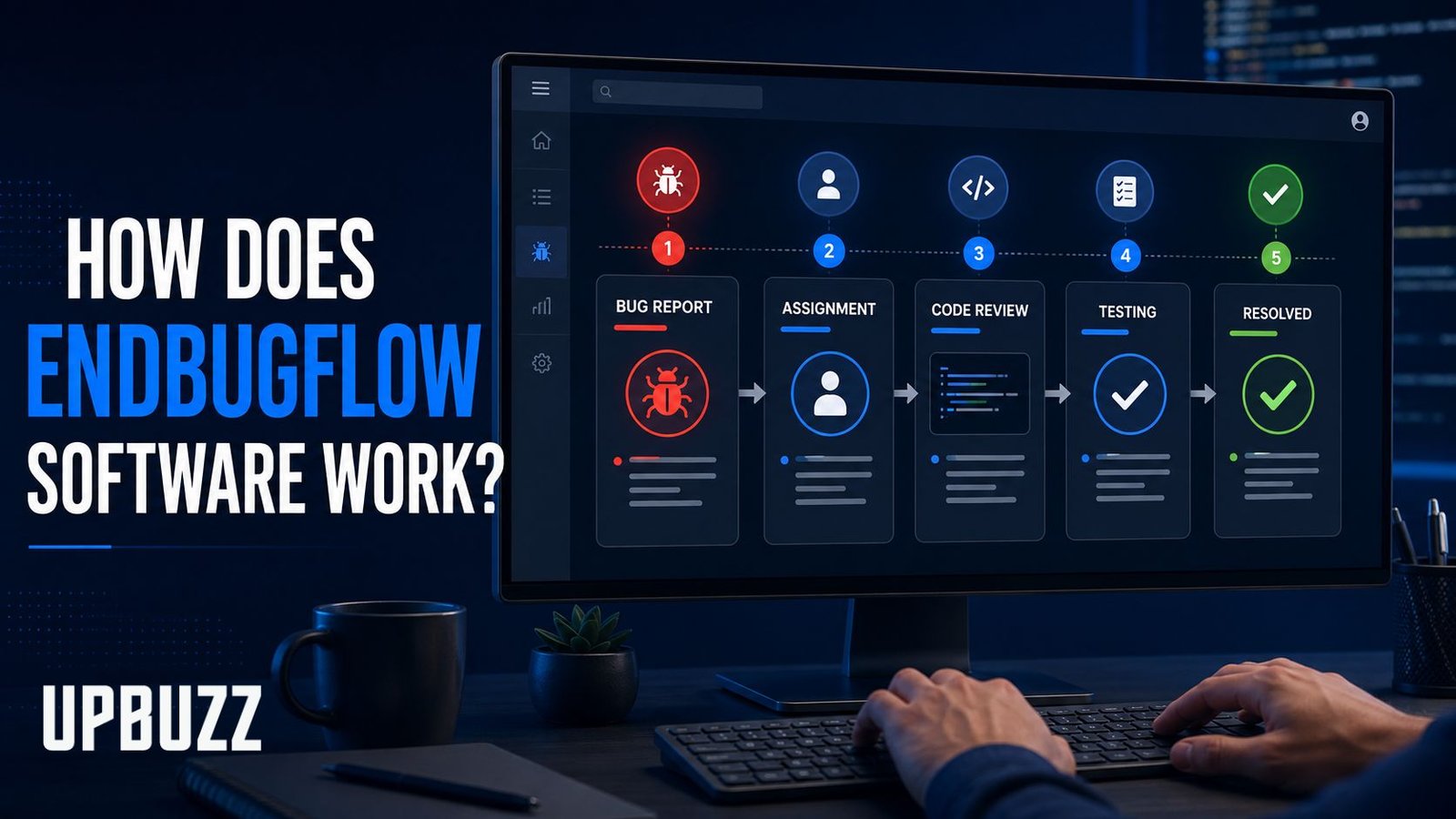
People searching for how does EndBugFlow software work are usually trying to understand a bug-tracking or workflow-management platform. Several online articles describe EndBugFlow as a system that captures software problems, creates issue records, assigns them to developers, and tracks each problem until it is fixed.
There is an important limitation, however. EndBugFlow does not currently have the kind of clear public documentation normally expected from an established software product. Its public-facing website presents Endbugflow mainly as a source of technical guidance about debugging, development workflows, and technology concepts. It does not clearly provide a product dashboard, installation package, pricing page, customer portal, or detailed integration documentation.
This means the workflow commonly attributed to EndBugFlow should be understood as a reported or conceptual model, not a fully verified list of product capabilities. With that distinction in mind, it is still possible to explain what the name appears to represent and how such a bug-management process would operate in practice.
Is EndBugFlow a Software Product or a Technical Platform?
The name creates some understandable confusion. Numerous third-party pages call it “EndBugFlow software” and describe features such as automated bug capture, intelligent task assignment, progress tracking, notifications, and reporting. These claims often resemble the standard capabilities of modern issue-tracking systems.
The public Endbugflow website, on the other hand, identifies itself more clearly as a technical information platform. Its stated areas of focus include debugging foundations, workflow optimization, technology concepts, and end-to-end debugging frameworks. It also publishes guides with software-related titles, but that alone does not confirm the existence of a separate commercial application.
No readily accessible first-party material clearly answers several basic product questions:
- Where users create an account
- Whether the platform runs in a browser or requires installation
- Which operating systems it supports
- What its pricing plans are
- Which development tools it officially integrates with
- How it stores or protects project data
- Whether it offers technical support or service guarantees
That absence does not prove that a private, early-stage, or limited-release tool does not exist. It simply means readers should avoid treating every feature mentioned elsewhere as established fact.
How Does EndBugFlow Software Work in a Typical Bug Cycle?
According to common online descriptions, EndBugFlow follows the familiar life cycle used by issue-management platforms: capture a problem, organize the available evidence, assign responsibility, monitor the repair, verify the result, and close the issue.
Here is what each stage would involve.
A problem enters the system
A bug record begins when someone reports unexpected behaviour. A tester might submit it manually after discovering a broken button, failed payment, layout problem, or application crash.
More advanced tracking systems can also receive error information from monitoring tools, application logs, testing services, or deployment pipelines. Several articles claim that EndBugFlow supports this kind of automated capture, but public first-party technical instructions confirming those connections are not currently easy to find.
A useful report normally includes the affected page or feature, the expected result, what actually happened, and the steps needed to reproduce the problem. Screenshots, videos, browser details, error messages, and log files can make the report considerably more useful.
The issue is classified
Once recorded, the bug needs context. Teams may label it by project, component, operating environment, severity, or type.
A spelling error on a rarely visited page, for example, should not receive the same attention as a security weakness or a checkout failure affecting customers. Classification prevents teams from treating every report as equally urgent.
Some descriptions say EndBugFlow can automatically rank problems according to impact. Without official documentation explaining its rules, it is safer to assume that prioritization may require human configuration or review. Even mature automation can misjudge business importance when it lacks context.
Responsibility is assigned
The issue then goes to a developer or team familiar with the affected component. In a small company, a project manager may choose the assignee manually. Larger organizations often use rules based on code ownership, technical speciality, workload, or project membership.
Third-party accounts sometimes describe EndBugFlow as recommending or selecting an appropriate developer. The precise assignment method, if such a feature is available, remains unverified.
Clear ownership is one of the most valuable parts of any bug workflow. It replaces vague group messages with a visible answer to a simple question: who is responsible for the next action?
Work moves through visible stages
A typical issue changes status as the team investigates and repairs it. The names vary between platforms, but the sequence often resembles:
| Status | What it usually means |
|---|---|
| Open | The issue has been recorded but work has not started |
| In progress | A developer is investigating or preparing a fix |
| Review | The code change is being checked |
| Ready for testing | A proposed fix is available for verification |
| Resolved | The team believes the problem has been corrected |
| Closed | Testing has confirmed the result |
This progression gives developers, testers, and managers a shared view of the work. Comments and attachments remain connected to the same record, reducing the need to search through separate emails or chat conversations.
The fix is tested before closure
A developer marking an issue as resolved should not automatically end the process. A tester normally repeats the original reproduction steps using a version of the software that contains the fix.
The tester also checks whether the change created a new problem elsewhere. If the bug remains, the record is reopened with additional evidence. If the repair works as expected, it can be closed.
This verification loop is central to proper bug management. A tool may organize it, but the quality of the outcome still depends on accurate reporting, careful development, and disciplined testing.
What EndBugFlow Would—and Would Not—Do
So, when someone asks how does EndBugFlow software work, the most reasonable interpretation is that it organizes the movement of an issue from discovery to verified resolution. It would act as a coordination layer rather than repairing source code by itself.
Bug-tracking software generally helps preserve evidence, show ownership, record decisions, and make progress visible. It may send notifications, apply workflow rules, or receive data from connected services. It cannot independently understand every product requirement or determine whether a change is safe in every situation.
This distinction matters because some explanations make issue trackers sound like fully automatic repair systems. Detecting an error is not the same as finding its root cause. Likewise, closing a ticket is not proof that the underlying defect has been corrected.
A Practical Example of the Reported Workflow
Imagine that customers can add products to an online store’s basket, but the checkout button stops responding on one mobile browser.
A tester first records the browser version, device type, page address, error message, and exact reproduction steps. The issue is classified as a checkout defect and given high priority because it blocks purchases.
The record is assigned to the developer responsible for the checkout interface. During investigation, the developer finds that a recent script change is incompatible with the affected browser. A correction is prepared, reviewed, and placed in a test environment.
The tester repeats the original steps and checks the checkout on several other browsers. If everything works, the issue is closed. The complete history remains attached to the record for future reference.
This example illustrates a standard end-to-end bug flow. It is a useful explanation of the process attributed to EndBugFlow, but it should not be read as proof of a particular interface, integration, or automated feature.
What to Check Before Using It
An unfamiliar development platform may receive sensitive material, including error logs, internal project details, source-code references, customer information, and integration credentials. Verification should therefore come before installation or connection.
Look for a clearly identified provider, genuine contact information, terms of service, a privacy policy, and an explanation of data storage. The provider should state whether information is encrypted, who can access it, how long it is retained, and whether users can permanently delete it.
Teams should also confirm role-based permissions, account recovery, backups, activity logs, integration scopes, and export options. A connection to a code repository should request only the access genuinely required for its function.
Until reliable documentation is available, avoid uploading private source code, passwords, access tokens, confidential client material, or production data. Testing an unfamiliar tool with a non-sensitive sample project is a more cautious approach.
Established alternatives such as Jira, GitHub Issues, GitLab Issues, Linear, YouTrack, Bugzilla, and MantisBT provide better-documented options for teams that need immediate issue tracking. The right choice depends on project size, repository location, workflow complexity, budget, hosting requirements, and security obligations.
Conclusion
The honest answer to how does EndBugFlow software work is less definite than many online explanations suggest. EndBugFlow is commonly portrayed as a bug-tracking system that records issues, prioritizes them, assigns responsibility, tracks repairs, and supports final verification. That model is logical and closely matches established development workflows.
However, its public identity is currently clearer as a technical content and debugging platform than as a fully documented software service. Features, integrations, pricing, security controls, and download instructions should therefore be confirmed directly before anyone relies on it for a real project.
Frequently Asked Questions
Is EndBugFlow a confirmed bug-tracking application?
Public articles frequently describe it that way, but accessible first-party product documentation is limited. Its website appears primarily focused on technical information and debugging guidance.
Does EndBugFlow automatically detect bugs?
Some third-party descriptions claim that it can collect errors from logs, pipelines, or connected development tools. This capability should not be considered confirmed without official integration documentation.
Does the software fix coding errors automatically?
There is no reliable evidence that it automatically repairs source code. The reported purpose is to organize issue reporting and resolution, while developers and testers perform the actual diagnosis, correction, and verification.
Is EndBugFlow safe to use?
There is not enough transparent security information to make a broad assurance. Users should examine ownership, privacy terms, permissions, encryption, data retention, and support arrangements before providing access to sensitive systems.
Where can EndBugFlow be downloaded?
A clearly verified official download page or application store listing is not readily available. Avoid unofficial installers, and do not download files claiming to be EndBugFlow unless their source and publisher can be independently confirmed.
Read more :Management Guide EWMagWork: What It Covers and How to Apply It at Work
