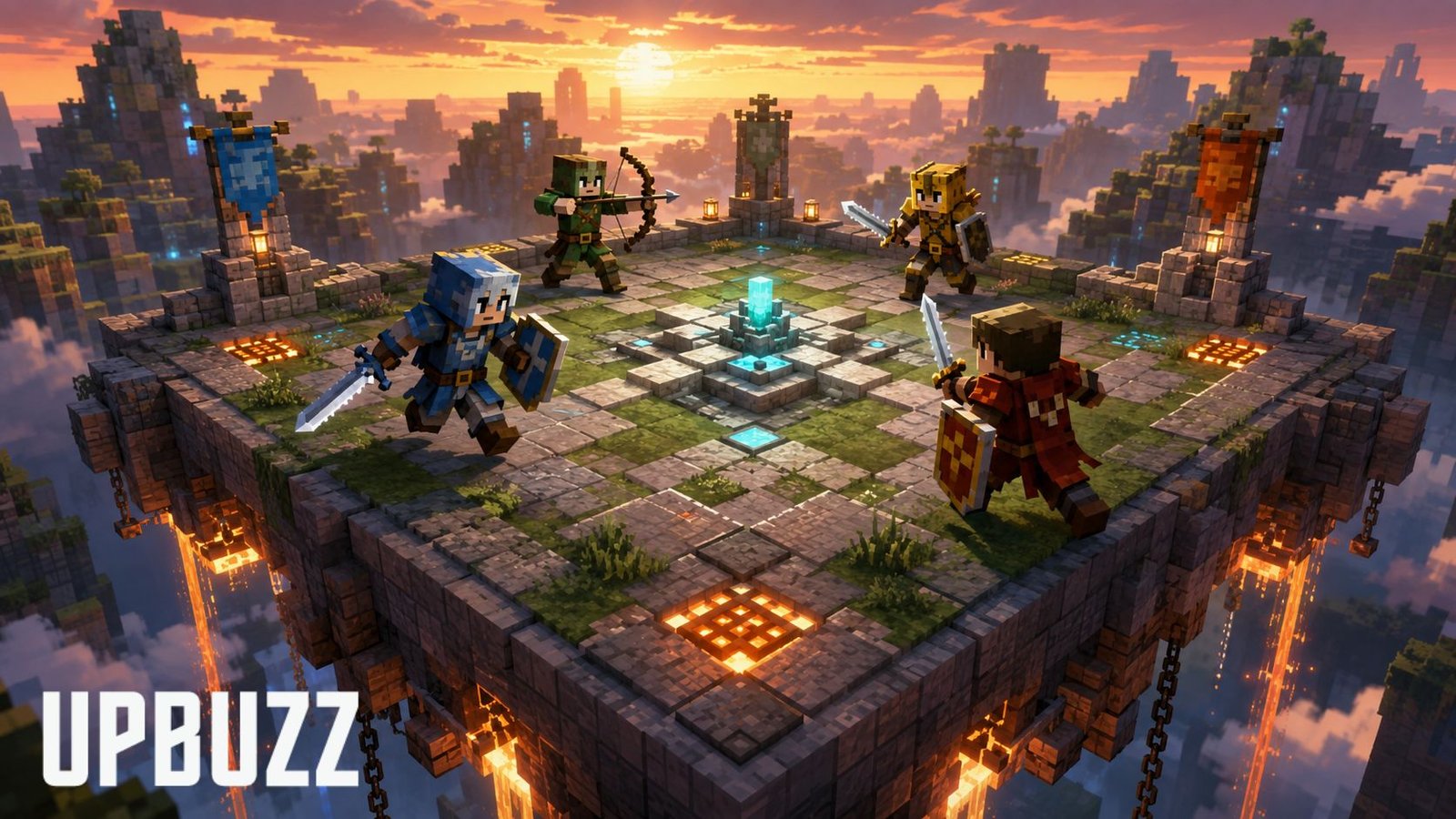
Minecraft has produced thousands of community-made minigames, from elaborate survival competitions to PvP arenas that last only a few minutes. Minecraft PlayBattleSquare appears to belong to the second category: a compact battle format built around quick rounds, limited equipment, careful movement, and control of a square arena.
There is an important detail to understand before trying to play. PlayBattleSquare is not presented by Mojang as an official Minecraft mode, and reliable public information about a dedicated server network, official download, or universally accepted rule set is limited. The name is also associated with a gaming website that publishes Minecraft guides and other gaming content.
The safest interpretation is that PlayBattleSquare describes a community-created PvP concept rather than a standard feature included with Minecraft. Its precise mechanics may therefore change depending on the server, map, plugin, or private world hosting it.
How Minecraft PlayBattleSquare Is Described
The basic idea is straightforward. Competitors enter a relatively small, square-shaped arena and fight using equipment selected by the host. A match may end when only one player remains, when a team reaches a target score, or when the round timer expires.
Arena edges are especially important. Some maps place the platform above the void, while others use drops, hazards, barriers, or designated elimination zones. This makes knockback almost as valuable as direct damage. A well-timed hit near the boundary may eliminate a better-equipped opponent without requiring a long fight.
Descriptions of the format commonly mention several possible variants:
- Free-for-all, in which every participant is an opponent
- Team battles with two or more groups
- Last-player-standing rounds without respawns
- Timed matches decided by eliminations or remaining health
- Hazard-based arenas with changing floors or shrinking safe areas
These should be treated as possible configurations, not guaranteed features. Community minigames often share a name while using different kits, scoring systems, arena designs, and combat rules.
PlayBattleSquare resembles several established Minecraft PvP formats. Its edge-based fighting is comparable to sumo arenas, its fixed equipment recalls kit PvP, and maps suspended over the void can feel similar to the final stages of SkyWars. The defining idea is not a particular item or map but the combination of a restricted battlefield and short, pressure-heavy combat.
What a Typical Match May Look Like
A round normally begins with competitors placed at separate spawn points. Movement may be temporarily locked during a countdown so that nobody gains an unfair head start. When the match begins, contestants either move toward the center or hold a safer position while watching how their opponents approach.
The supplied kit determines the pace. Swords encourage quick melee exchanges, axes reward deliberate timing, and bows make open lanes dangerous. Shields, food, healing items, blocks, or projectiles can add further tactical choices. A minimal kit keeps attention on movement and knockback, while a larger inventory makes resource management more important.
The shape of the arena also affects every decision. Open square platforms favor strafing and ranged attacks. Obstacles provide cover but create blind corners. Broken flooring makes aggressive movement risky, while elevated sections can offer better visibility at the cost of an exposed position.
Because no authoritative universal ruleset has been published, prospective participants should check the host’s instructions before a match. Important questions include whether block placement is allowed, whether defeated players respawn, how ties are settled, and whether environmental eliminations count toward the score.
| Match element | What to verify |
|---|---|
| Edition | Java or Bedrock |
| Combat rules | Weapons, shields, healing, and allowed techniques |
| Elimination | Health loss, falling, score limit, or timeout |
| Respawning | Disabled, limited, or unlimited |
| Arena behavior | Static floor, hazards, or shrinking play area |
| Team rules | Team size, friendly fire, and communication limits |
How to Find and Join a Match
There does not appear to be one clearly verified, universal server address for PlayBattleSquare. Be cautious with pages that promise immediate access without identifying the Minecraft edition, server version, administrator, or rules.
If a legitimate community advertises the mode, it should provide an address and basic connection details. Java Edition users generally join through the Multiplayer menu by selecting “Add Server” or “Direct Connection.” Bedrock users on Windows and mobile devices can use the Servers section when custom server entry is available. Console editions place greater restrictions on adding outside servers and generally emphasize featured networks.
Before connecting, confirm that your game version matches the server. A Java address will not normally work in Bedrock unless the host has deliberately configured cross-platform support. Modded servers may also require a particular loader or modpack, but ordinary players should not install unknown files merely because a page claims they are necessary.
Once connected, look for a minigame selector, lobby character, signboard, or documented command. The mode may appear under a broader PvP category rather than under its full name. If the server does not mention PlayBattleSquare anywhere, do not assume that an unrelated battle arena is the same game.
Winning Is Mostly About Space, Not Constant Attacking
New competitors often focus entirely on landing more hits. In a confined arena, position can matter more. Fighting beside an edge gives an opponent an easy knockback opportunity, whereas holding a central lane creates several possible escape routes.
That does not mean rushing to the middle is always correct. A crowded center can expose you to attacks from several directions. The better approach is to notice where opponents are looking, keep a safe route behind you, and avoid becoming trapped between another fighter and the boundary.
Movement should be controlled rather than frantic. Strafing makes attacks harder to predict, but repeated jumping can produce an obvious rhythm. Sprinting everywhere may also make it harder to change direction at the right moment. Use crouching carefully near exposed edges, particularly when the arena allows building or contains gaps.
Equipment deserves the same discipline. Do not spend every arrow during the opening seconds or use healing after minor damage when recovery is limited. Projectiles can interrupt an advancing opponent, force someone away from a strong position, or create an opening for a push. Even a weak ranged item may be decisive when knockback can cause elimination.
In team modes, short callouts are more useful than constant conversation. Teammates need to know where a push is developing, which opponent is vulnerable, and whether somebody is approaching from behind. Chasing one injured player across the map while abandoning the team is a common way to lose control of the arena.
Java and Bedrock combat do not behave identically, so advice cannot be transferred perfectly between them. Attack timing, shields, movement, and knockback may feel different. Server plugins can alter those mechanics further. Practice on the actual server is consequently more valuable than memorizing a supposedly universal technique.
Creating a Private PlayBattleSquare-Style Arena
A private version can be built without claiming to reproduce an official map. Start with a symmetrical platform so that each spawn has comparable access to cover and central space. Mark the boundaries clearly and place spectators where they cannot interfere.
The host then needs to decide how rounds start and end. A simple friends-only game can be managed manually, while repeated matches may benefit from commands, command blocks, a datapack, or a suitable server plugin. Automation can distribute kits, teleport contestants, detect eliminations, reset the arena, and announce winners.
No single verified “official PlayBattleSquare plugin” should be assumed to exist. Examine the reputation, update history, requested permissions, and source of any server extension before installing it. Back up the world first and test the complete match flow privately.
Fairness matters more than decorative complexity. Equal spawn positions, clearly explained kits, reliable arena resets, and consistent rulings will produce better matches than an impressive map with hidden advantages.
Safety and Reliability
The PlayBattleSquare website appears to function primarily as a gaming-content publication. Visiting an article is not the same as connecting to a Minecraft server, and a webpage cannot place a player into an official game session by itself.
Never enter Microsoft account credentials directly into an unfamiliar gaming site. Account authentication should take place through the official Minecraft launcher and recognized Microsoft services. Avoid unverified launcher files, unofficial account tools, and mysterious .jar downloads. Server addresses, maps, plugins, and resource packs should come from identifiable communities with clear moderation policies.
Younger users should have a parent or guardian review public servers, especially when they include open chat, outside community groups, purchases, or player-to-player trading.
Conclusion
Minecraft PlayBattleSquare is best understood as a community PvP arena concept built around short rounds, restricted space, knockback, and quick decision-making. Available descriptions provide a useful picture of how such matches can operate, but they do not establish one official server, plugin, or fixed ruleset.
Verify the edition, address, rules, and download source before joining. Once inside a legitimate match, success comes from reading the arena, protecting escape routes, managing limited equipment, and choosing attacks with purpose.
Frequently Asked Questions
Is PlayBattleSquare an official Minecraft game mode?
No official Mojang material identifies it as a built-in mode. It appears to be a community-created PvP concept associated with independent gaming content.
Is there an official PlayBattleSquare server address?
A single authoritative server address could not be reliably confirmed. Use only connection details supplied by an identifiable and trusted server community.
Can Bedrock Edition players join?
That depends on the host. A server must support Bedrock or provide properly configured cross-platform access. Java server addresses do not automatically work in Bedrock.
Do I need to download a mod?
Not necessarily. A server can run a minigame using server-side plugins or commands. Do not install a mod unless the host clearly explains why it is required and the download comes from a reputable source.
Can I build my own version?
Yes. A square arena, balanced spawn points, agreed kits, and clear elimination rules are enough for a basic private match. Commands or server extensions can automate more advanced rounds.
Read more :Feedbuzzard Advertise: What Businesses Should Know Before Buying a Campaign
